Indication
When one or more heart valves do not function properly, this is called valve disease. If a valve is leaking and/or narrowed, you may experience symptoms such as tiredness, shortness of breath or dizziness because not enough blood is being pumped around the body.
Reasons to opt for heart valve surgery instead of medication or a catheter-based procedure include your symptoms, your age, the nature and severity of your valve disease, and any associated medical problems (such as coronary artery disease) that require heart surgery.
Types
The cardiac surgeon can either repair or replace a valve. When there is valve leakage only, the valve can usually be repaired. If this is not possible, it has to be replaced. In many cases, the final decision about the type of procedure can only be made during the operation. In valve stenosis, the valve is almost always replaced.
Valve repair
Valve repair (valvuloplasty) is mainly used for leaking mitral, aortic and/or tricuspid valves.
During the operation, the surgeon inspects the quality of the valve tissue (leaflets). If it is of good quality, the surgeon will repair the valve. Often, the repair is reinforced with a synthetic ring placed around the valve (annuloplasty).
Valve repair has several advantages compared with valve replacement:
- You do not need to take lifelong blood-thinning medication.
- Your risk of infection of the heart valve (endocarditis) is lower.
- Your risk of stroke is lower.
- The pumping function of your heart works better.
- Your long-term survival prospects are better.
Valve replacement
If the valve cannot be repaired, it is removed and replaced by a valve prosthesis. There are different types of valve prostheses, each with specific advantages and disadvantages. The choice depends on your age, which valve is affected and any other medical problems. Before the operation, the cardiac surgeon will discuss the preferred option with you.
1. Biological valve prosthesis
A biological valve prosthesis is made from animal tissue (bovine pericardium or pig valve leaflets) mounted on a frame.
- In principle, you do not need strong blood-thinning medication, which lowers the risk of bleeding.
- The valve prosthesis does not make a ticking sound.
- Biological valve prostheses wear out and therefore do not last a lifetime. Significant wear can already appear from about five years after the operation. Their average lifespan is 15–20 years. They are therefore usually implanted in patients from about 55–60 years of age for the aortic valve and 65–70 years for the mitral valve. The lifespan of the prosthesis mainly depends on the age at which the valve replacement is performed.
- There is a higher risk of infection of the heart valve (endocarditis). Taking preventive antibiotics before any invasive medical procedure is recommended lifelong.
2. Mechanical valve prosthesis
In a mechanical valve prosthesis, the valve leaflets are made from hard-wearing material (such as carbon or metal). The valve mechanism is surrounded by a synthetic ring that allows it to be sewn into the heart tissue.
Mechanical valve prostheses are very durable and in principle last a lifetime, which makes them particularly suitable for younger patients (< 65 years). The chance of needing a further operation is low (around 0.6% per year).
- Because of the increased risk of blood clots forming on the surface of the valve prosthesis, you must take strong blood-thinning medication for life. This requires regular blood tests and increases the risk of bleeding and thrombosis.
- There is a higher risk of infection of the heart valve (endocarditis). Taking preventive antibiotics before any invasive medical procedure is recommended lifelong.
- Pregnancy is strongly discouraged.
- The valve prosthesis makes a ticking sound. How bothersome this is varies from person to person.
3. Ross procedure
The Ross procedure is a good alternative for children and adults (under 60 years of age) who need a new aortic valve.
In this procedure, the diseased aortic valve is removed and replaced by your own pulmonary valve (the valve between the right ventricle and the pulmonary artery). Because you are both donor and recipient of this valve, this is called an autograft. The pulmonary valve is then replaced by a homograft, a donor valve (from a deceased person) that has been specially treated in the laboratory for use as a prosthesis.
- Your quality of life is comparable to that of people who have not undergone aortic valve replacement.
- There is a limited risk of major bleeding, stroke or early deterioration of the heart valves.
- You do not need to take strong blood-thinning medication for life after the procedure.
- The Ross procedure results in optimal haemodynamics.
- The risk of infection of the heart valve (endocarditis) is lower.
- You may become pregnant.
- This operation is surgically more complex than a standard valve replacement. In an experienced centre such as UZ Leuven, however, the Ross procedure can be performed with a similar operative risk.
- The chance of needing another operation is lower than after valve replacement with a biological prosthesis, but still slightly higher than after implantation of a mechanical valve.
Course of the operation
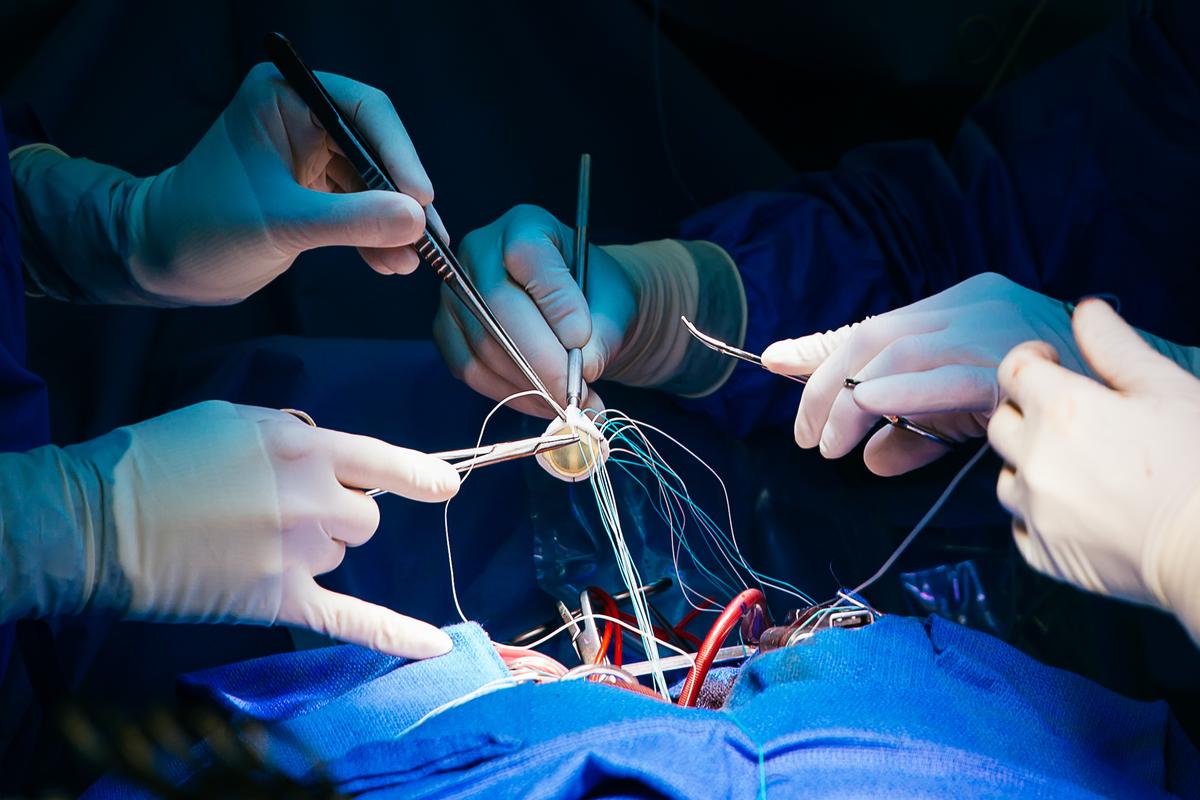
Heart valve surgery takes on average 4–6 hours and is carried out under general anaesthesia. The exact duration, set-up and course of the operation vary according to the type of procedure. The operative risk depends on the severity of the valve disease, any associated medical problems and how urgent the operation is.
Conventional heart valve surgery via the breastbone
- The breastbone is opened from top to bottom to reach the heart. The medical term for this is “sternotomy”.
- The heart-lung machine temporarily takes over the function of the heart and lungs, allowing the heart to be stopped so that the valve or valves can be operated on.
- The surgeon then opens the heart and decides whether the diseased valve will be repaired or replaced. If it is to be replaced, the diseased valve is first removed before the new prosthesis is implanted.
- The heart-lung machine is then switched off and the heart starts beating again.
Heart valve surgery via minimally invasive access
In some cases, a heart valve can be repaired or replaced through smaller cuts (incisions) in the chest, known as minimally invasive access.
Where possible, minimally invasive heart surgery is preferred over open-heart surgery because it offers certain advantages: recovery is usually shorter and the cosmetic result is better.
Whether you are eligible for this approach depends on the type and severity of your heart condition, the anatomy of your chest and any associated medical problems (such as the need for coronary bypass surgery).
Click on the minimally invasive procedures for more information.
For some valve operations, a mini-sternotomy is sufficient. In this case, only the upper part of the breastbone is opened and the operation is carried out through a smaller incision.
In a videoscopic procedure, the heart is approached through several small incisions on the right side of the chest. The surgeon passes between the ribs to reach the heart. A small incision is also made in the groin to connect the heart-lung machine.
A small video camera or thoracoscope is used. This camera, together with the surgical instruments, is introduced into the chest through the small incisions. In English, this video-assisted technique is called Video Assisted Thoracoscopic Surgery (VATS).
This procedure is most commonly used to treat the mitral, tricuspid and/or aortic valve. The technique is also used for myectomy or closure of a septal defect.
Click here for more information about how your heart operation is carried out.
In patients for whom the risk of conventional heart surgery is too high, valve disease can be treated by catheter-based procedures via the vessels in the groin, the neck or a large vessel near the collarbone.
For this procedure, the heart-lung machine is usually not needed. It is performed under local or general anaesthesia. If the quality of the vessels is insufficient, it may be decided to reach the diseased valve via the tip of the heart, which requires a small incision in the chest.
More about how your operation is carried out
Click here for more information about how heart surgery is performed.
Appointments
-
+32 16 34 42 60 - weekdays from 08:30 to 12:00 and 13:00 to 16:30