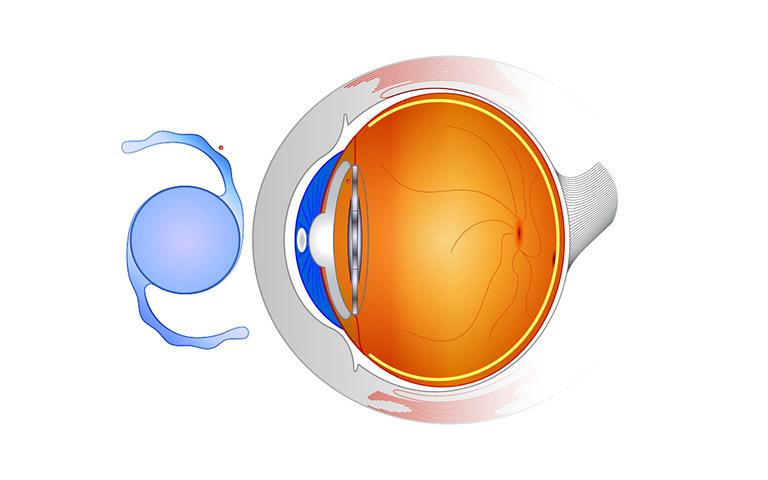
Types of implantable lenses
Lens replacement can correct distance and/or near vision in several ways.
Monofocal artificial lens
Monofocal means that the artificial lens provides clear vision at only one distance, usually in the distance. Reading glasses are therefore almost always required for near vision. Glasses may sometimes also be needed to improve distance vision further.
Multifocal artificial lens
With this artificial lens, we aim to provide clear distance vision without glasses. There is also a very good chance that you will be able to see clearly at near distances at the same time. Reading glasses will then no longer be required.
Toric artificial lens
This artificial lens is a monofocal lens that also corrects the cylindrical refractive error known as astigmatism. Reading glasses are almost always required for near vision in this case.
Multifocal toric artificial lens
This is a multifocal lens that also corrects the cylindrical refractive error known as astigmatism. As with a conventional multifocal lens, the aim is to provide clear distance vision without glasses. There is also a very good chance that you will be able to see clearly at near distances at the same time. Reading glasses will then no longer be required.
If you frequently need to drive at night, a monofocal artificial lens combined with reading glasses may be the best choice for you.
In most cases, a multifocal or multifocal toric artificial lens is chosen. However, a multifocal lens has some disadvantages. To read clearly with a multifocal artificial lens, you need sufficient light. Some visual side effects may also occur, such as:
- reduced visual acuity in fog or low light;
- seeing rings or circles around lights at night, for example around car headlights, which may make driving at night difficult;
- greater difficulty distinguishing objects against a dark background, particularly in low light.
If you frequently need to drive at night, a monofocal artificial lens combined with reading glasses may be a better choice for you.
Screening and preliminary assessment
During a preoperative examination, the ophthalmologist will assess whether you are eligible for lens replacement. A number of specialised examinations are used to assess several parameters in the eye and determine whether you are suitable for the procedure.
Before the preliminary assessment, you must stop wearing contact lenses for a period of time.
- Hard contact lenses: stop wearing them 3 weeks before the examination.
- Toric soft contact lenses: stop wearing them 3 weeks before the examination.
- Overnight contact lenses: stop wearing them 3 weeks before the examination.
- Soft contact lenses: stop wearing them 10 days before the examination.
Preparation
If you opt for topical anaesthesia using eye drops during the procedure, you do not need to fast.
If you opt for a general anaesthetic during the procedure, you must fast. Follow any specific instructions provided by the anaesthetist.
Procedure
The procedure is performed during a day-case admission. If both eyes are being treated, the second eye is operated on approximately 10 days to 2 weeks after the first procedure.
You will be awake during the operation because a local anaesthetic is used. You will not be able to see what is happening, but you will probably be aware of a bright light.
Just before the operation, you will be given eye drops to dilate your pupil. Your eye will then be anaesthetised. The anaesthetic may be administered as eye drops, but a local anaesthetic solution may also be injected into the tissue surrounding your eye.
During the operation, you will be asked to keep your head still and remain lying down without moving for approximately 20 minutes. Ultrasound waves will soften your lens, which is then removed through a narrow tube. This technique is known as phacoemulsification. The posterior layer of the lens, known as the posterior lens capsule, remains in place. An artificial implantable lens is then inserted to replace your own lens. A small suture is sometimes also placed in the eye.
At the end of the operation, an eye shield may be placed over your eye for protection.
Before the operation, eye drops are administered to dilate the pupil. Anaesthetic drops are then also administered.
- Three small incisions are made in the eye, through which instruments can be inserted.
- The eye is filled with a gel.
- Using fine forceps, a round opening approximately 5 mm in diameter is made in the anterior lens capsule.
- The lens contents are flushed away from the lens capsule.
- The lens is broken up into four pieces using ultrasound. This softens the lens, which is then removed through a narrow tube (phacoemulsification).
- The small lens fragments are removed. The rear layer of the lens, the posterior lens capsule, remains in place.
- An artificial lens is then inserted to replace your natural lens. After the operation, a protective patch may be placed over your eye.
After the procedure
- You may not drive until your doctor has given you permission, so arrange transport home.
- You may resume normal activities such as reading, watching television, working at a computer and doing light household tasks immediately after the procedure.
- You will be prescribed eye drops to prevent infections and inflammation.
The day after the procedure
You will return for a follow-up consultation. Arrange transport for this appointment as well, as you must not yet drive yourself.
The week after the procedure
- Your vision will improve gradually during the week after the procedure.
- Use the prescribed eye drops several times a day.
Possible risks
Lens replacement involves several possible risks:
- overcorrection or undercorrection;
- seeing halos, or circles and rings around light sources;
- infections;
- swelling of the cornea or central retina;
- retinal detachment or worsening of a pre-existing condition.
The doctor will discuss these risks with you in detail during your initial consultation.
Cost and reimbursement
The cost of lens replacement varies depending on the type of lens implant you choose. The doctor will provide more information during the consultation.
If you do not have a cataract, lens replacement is generally not reimbursed by the health insurance fund.
Frequently asked questions
You will not normally experience pain after lens replacement. However, your eyes may water and you may feel as though there is a grain of sand in your eye.
You will be prescribed anti-inflammatory eye drops to promote healing of the eye.
If you experience pain during the first 24 hours after the procedure, you may take 1 painkiller every 6 hours.
You will attend a follow-up examination the day after the procedure.
You may only drive once your doctor has given you permission. You must arrange transport to attend the follow-up examination on the day after the procedure.
You will be prescribed eye drops to prevent infections and inflammation.
If you experience pain during the first 24 hours after the procedure, you may take 1 painkiller every 6 hours.



Interested in life without glasses?
Would you like to know whether you are eligible for life without glasses? Take the ‘Quickscan’: a screening test consisting of a few brief technical eye examinations and a short questionnaire. Quick, painless and completely without obligation.