Alternative to laser eye surgery
Are you not eligible for laser eye surgery? An implantable contact lens (ICL) may be an alternative.
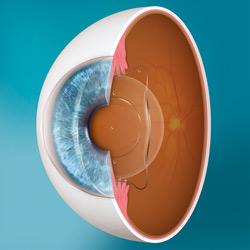
Implantable contact lens (ICL)
Implantable contact lens
An ICL is placed in the front part of the eye: behind the iris, the coloured part of the eye, and in front of the natural lens.
Characteristics of the lens
Natural material
The lens is made of collagen, a substance naturally found in your body. This makes the lens compatible with your eye, so you will not experience rejection.
Soft and flexible
The ICL is flexible, making it easy to insert into your eye. Once in place, the lens feels very natural.
Built-in UV filter
The composition of the lens provides protection against ultraviolet light.
Eligibility criteria
To be eligible for an implantable contact lens (ICL), you must meet the following criteria.
- Age: 21 to 45 years
- Myopia: between −4 D and −20 D
- Hyperopia: between +2 D and +10 D
- Astigmatism: between 0.5 D and 6 D
Price of an ICL
The price of an ICL depends on the lens power. The doctor will provide more information during the consultation.
Reimbursement
The health insurance fund does not contribute to the cost of ICL implantation.
Screening and preliminary assessment
We use a number of specialised examinations to measure several parameters in the eye and determine whether you are a suitable candidate.
Before the preliminary assessment, you must stop wearing contact lenses for a period of time:
- Hard contact lenses: 3 weeks
- Toric soft contact lenses: 3 weeks
- Overnight contact lenses: 3 weeks
- Soft contact lenses: 10 days
Preparation
- If you opt for topical anaesthesia using eye drops, you do not need to fast. If general anaesthesia is used, you must fast.
- Arrange for someone to drive you home. You must not drive until your doctor has given you permission.
- Do not wear contact lenses on the day of the procedure.
Procedure
The procedure is performed as a day case. If both eyes are being treated, the second eye is operated on approximately 7 days after the first.
Duration of the procedure: 20 to 30 minutes.
- You will be given eye drops to dilate your pupil and numb your eye.
- The eye surgeon makes a small incision in the cornea through which to insert the lens.
The procedure is painless because of the anaesthetic. - The folded ICL is inserted through the incision.
- The doctor positions the lens correctly inside the eye.
Video (in Dutch)
- The surgeon makes an initial incision.
- Space is created within the eye using a gel.
- The surgeon makes two further incisions, one of which is larger.
- The folded lens is inserted into the eye very slowly through the larger incision.
- Once the lens has unfolded, more gel is injected into the eye to create space.
- The edges of the lens are tucked beneath the iris (also known as the rainbow membrane).
- Finally, the gel is removed from the eye, an antibiotic is administered and the incisions are checked.
The procedure is carried out using the high-tech Callisto system. This projects the position of the eye onto the microscope through which the surgeon is looking.
The eye is flushed regularly so that the surgeon can see clearly during the procedure.
Aftercare
You will not normally experience any pain after ICL implantation.
On the day of the procedure
- Four hours after the procedure, your intraocular pressure will be checked.
If it is normal, you may go home. - Arrange for someone to drive you home.
You may not drive until your doctor has given you permission. - You will be prescribed eye drops to prevent infections and inflammation.
- Normal activities such as reading, watching television, working at a computer and doing light housework are permitted immediately.
If you experience pain during the first 24 hours after the procedure, you may take 1 painkiller every 6 hours.
The day after the procedure
- You will attend a follow-up examination.
- Arrange transport: you may not drive yourself.
The week after the procedure
- Your vision will improve gradually during the week after the procedure.
- Do not rub your eyes for 1 month after the procedure.
- You will be given an eye shield to wear at night. This prevents you from rubbing your eyes while asleep.
- Do not lift heavy objects, to avoid increasing the pressure in your eye.
- Use the prescribed eye drops several times a day.
Risks
Possible risks associated with an ICL include:
- Over- and undercorrection
- Halos and glare at night
- Infection
- Swelling of the cornea or central retina
- Severely elevated intraocular pressure
- Increased sensitivity to light
The doctor will discuss these risks with you in detail during your initial appointment.
Frequently asked questions
In most cases, this does not cause any problems.
We advise you not to wear eye make-up for 2 weeks after the procedure. Removing eye make-up involves rubbing the eye.
If you have an anterior chamber lens, you must avoid rubbing your eye firmly for the rest of your life. We strongly advise all patients not to rub their eyes.
You may walk and cycle gently from the day after the treatment. Wear sunglasses in windy or sunny conditions.
Crying may cause a stinging sensation, but it does not affect the outcome.
We strongly advise all patients not to rub their eyes. However, after 2 weeks, you can safely touch the eye again.
After the screening examination, you will return for an ultrasound scan.
The ultrasound examination will help determine the size of the implantable lens. In addition, the eye will be checked carefully for other abnormalities.
Eye drops will also be administered to temporarily prevent your eye from focusing. As a result, your vision will be blurred for 24 to 48 hours. Your retina will also be examined that same day.
You can go home that same day. We will carry out one final check 2 to 3 hours after the procedure. If everything is normal, you can go home afterwards. In practical terms, you will spend half a day at the hospital.
- Soft contact lenses: 10 days
- Toric contact lenses and rigid gas-permeable contact lenses: 3 weeks
You can go home that same day. We will carry out one final check 2 to 3 hours after the procedure. If everything is normal, you can go home afterwards. In practical terms, you will spend half a day at the hospital.
We will see you again 1 day, 1 week, 1 month and 6 months after the procedure. Thereafter, we will schedule a follow-up appointment every 2 years. We recommend arranging for someone to drive you on the day after the procedure.
Approximately 5 to 7 days after the first eye.
Depending on your occupation, you may be given a medical certificate for a few days off work.
Depending on your occupation, you may be given a medical certificate for a few days off work.
We advise you not to lift heavy objects during the first 2 weeks after the procedure. Light housework is not a problem.
We advise you not to take part in contact or ball sports for 1 month.
Brochure



Interested in life without glasses?
Would you like to know whether you are eligible for life without glasses? Take the ‘Quickscan’: a screening test consisting of a few brief technical eye examinations and a short questionnaire. Quick, painless and completely without obligation.