Appointments
-
Not yet a mynexuzhealth user? Request an appointment online.
-
Call +32 16 33 23 40
- Mondays to Thursdays from 08:00 to 18:00
- Fridays from 08:00 to 17:00
-
Already a patient with us? Request your medical certificate or prescription.
Types of hearing aids
Models may change and are shown here for illustration only.
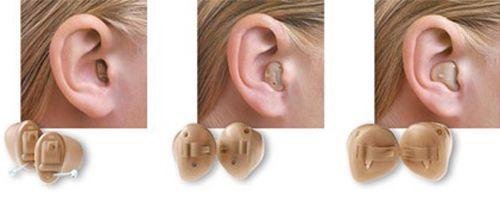
In-the-ear hearing aids
For people with mild to moderate hearing loss and a nearly flat pattern of loss, meaning the same degree of loss across the different frequencies.
- Almost invisible because these hearing aids sit entirely inside the ear
- Use the pinna’s natural ability to locate the source of sound.
- Can cause a blocked feeling and muffled sound.
- More prone to faults.
Mini behind-the-ear hearing aids
- Very discreet and comfortable behind the ear.
- Easy to put on.
- Very natural sound quality.
- With a thin tube and an invisible, flexible earpiece in the ear canal.
- For people with fairly good hearing at low and middle frequencies.

For greater hearing loss, both systems can be adapted with a custom-made earmould or shell. An impression of the ear canal is needed to make a custom earmould.
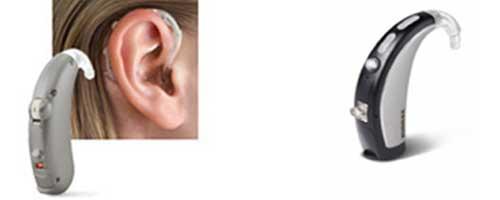
Power behind-the-ear hearing aids
- A hearing aid behind the ear that is connected to an earmould by a tube.
- Suitable for everyone, even people with severe hearing loss. For very severe hearing loss, there are also ‘Super Power’ devices. These are slightly larger because they need a more powerful speaker that provides extra amplification.
- With or without a volume control.
- Easy to operate.
- Available in all price ranges.
- An impression of the ear canal is needed to make a custom earmould.
If the result is insufficient, an acoustic implant or cochlear implant may be needed. Discuss this with your ENT specialist or hearing centre.
Support research on hearing welfare
Hearing problems have a major impact on quality of life and can lead to anxiety, depression and social isolation. On average, people wait seven to ten years to seek help. Around 466 million people worldwide suffer from hearing problems. By 2050, there will be an estimated 900 million.
Much research is still needed on timely detection of hearing loss in both young and elderly people. Would you like to support research on hearing wellbeing? You can do so through KU Leuven's patronage.