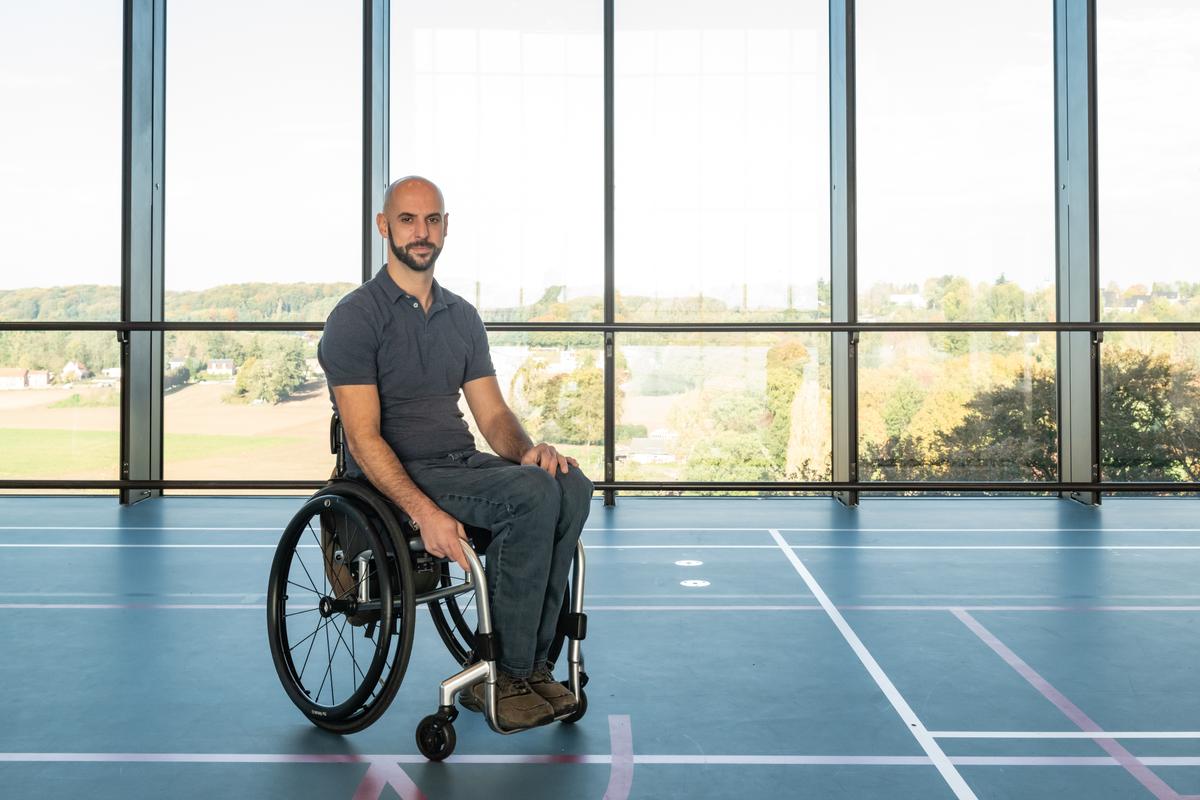
How did you start volunteering?
When I was undergoing rehabilitation in Pellenberg, there were no peer experts yet. Fortunately, I met people at the sports club for disabled people who had been in a similar situation for a long time.
During a later hospitalisation, I also met a fellow patient who taught me a lot. Those testimonials meant a great deal to me at the time.
The project involving peer experts was launched as part of a PhD study. So when I was asked if I was interested, I didn't have to think twice about jumping on board.
What exactly does assignment entail? What do you prefer doing?
The most satisfaction I get when I can help people in rehabilitation with practical matters: wheelchair skills, transfers, equipment choices …
There are also plenty of moments when you just need to be a listening ear and they need to tell you their story.
When patients undergoing rehabilitation feel discouraged, I try to get them back on track and encourage them to get as much out of their rehabilitation as possible.
I find it difficult when patients undergoing rehabilitation lose heart. I try to get them back on track and encourage them to get as much out of their rehabilitation as possible.
What motivates you to keep going?
I notice that rehabilitation patients really need this kind of contact and that most of them are open to it.
Many patients come to me with questions and are genuinely interested in the subject. You realise that you can be very useful and that you are helping people. I get a lot of satisfaction from that.
What has been your best experience as a volunteer so far?
The wheelchair training sessions and exercising together are moments that stay with me. I myself enjoy sports very much and do them a lot, and I notice how good it is for both your physical and mental health.
The strength you gain from exercising together and being active brings people out of their isolation and has a healing effect.
That's why I enjoy encouraging others to participate in sports during and after their rehabilitation.
Moreover, exercising helps you forget your worries for a while and simply enjoy yourself. It makes you forget about the wheelchair you are in or the prosthesis you have.
The strength you gain from being active together brings people out of their isolation and has a healing effect.
Do you take certain aspects from volunteering into your daily life?
There are patients of all ages and backgrounds, and it is therefore a challenge to deal with all these different types of people.
Every person is unique and require their own personal approach. During the COVID-19 period, there were more geriatric patients in the departments where I work.
You don't need to tell an older person that they still have a whole life in front of them.
You have very different conversations than you would with younger people. You learn to appreciate people for who they are.
Hoe wil jij met je vrijwilligerswerk een verschil maken voor de patiënten?
Ik wil een luisterend oor zijn voor revalidanten en hen een toekomstperspectief geven. Your life is not over just because you are in a wheelchair.
You can still lead a fulfilling life. It might be different, but you can still have a good quality of life.
Just as there are people who inspire me to do this, I also want to set an example for others through my commitment as an expert by experience.
Do you have a motto in life?
‘The glass is not half-empty, but rather half-full.’